

Key Takeaways
-
Caster selection should consider load, flooring, speed, and payload sensitivity.
-
Shock-absorbing casters can help manage vibration, bounce, and impact.
-
Dual-wheel designs can support load distribution and equipment stability.
-
Review travel conditions and caster geometry before choosing a system.
-
R.T. Laird, Inc. provides application-focused caster solutions for demanding equipment.
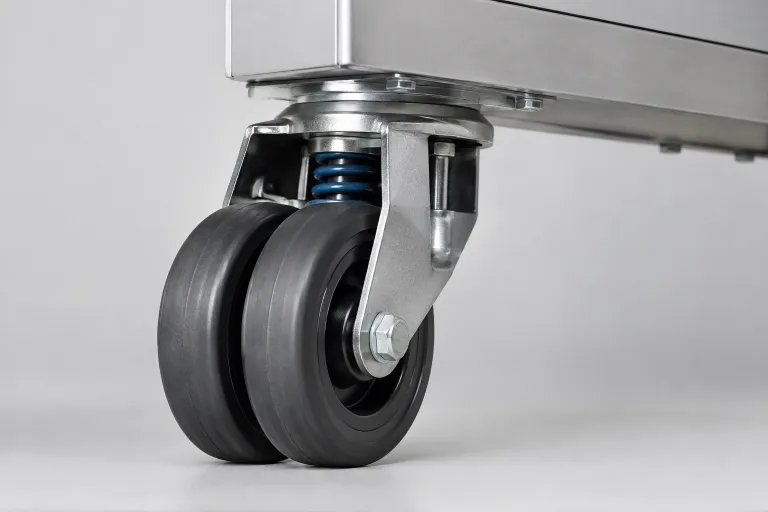
Moving heavy industrial equipment is rarely as simple as selecting a wheel with enough rated capacity. Cracks, thresholds, expansion joints, ramps, worn concrete, and surface transitions can send impact forces upward through a cart frame and into the payload. For organizations that need more control over that motion, dual wheel shock absorbing casters from R.T. Laird, Inc. are designed to help manage shock, vibration, bounce, and noise while supporting demanding mobile-equipment applications.
R.T. Laird, Inc. approaches caster selection as a complete mobility-system issue. The objective is not simply to make a cart roll, but to consider how the floor, wheel material, load, spring response, mounting arrangement, travel speed, and payload sensitivity work together. That distinction matters when a platform carries expensive tooling, electronics, aerospace hardware, medical equipment, or other loads that may be affected by abrupt movement.
Why Is Heavy-Load Movement Difficult on Uneven Surfaces?
When a wheel encounters an obstacle, the equipment continues to experience force, even as the cart continues forward. The impact can create vibration in the frame, momentary load shifts, rattling, noise, and dynamic bounce. A rigid caster or a caster with limited deflection may transfer a larger share of that event into the vehicle and its payload.
Floor conditions can also affect the people operating the equipment. Moving carts over bumpy or rough terrain may expose workers to abrupt, jarring impacts, which is one reason wheel condition, travel routes, handle design, and pushing force deserve attention during equipment planning.
For a heavy cart, repeated impact can lead to inconsistent wheel contact and uneven load transfer. That can make a platform feel less stable, particularly when the center of gravity is high, the load is offset, or the equipment must turn frequently. The right caster system should be evaluated for the actual operating environment rather than chosen based solely on capacity.
How Does R.T. Laird, Inc. Approach Shock Isolation?
Why Does Spring Rate Matter?
Spring rate describes how resistance changes as a spring or isolating mechanism deflects under load. R.T. Laird, Inc. explains that conventional casters with limited spring deflection can have relatively high initial and final spring rates. In practical terms, that means the caster may respond more abruptly as it encounters surface irregularities or approaches the limits of its travel.
R.T. Laird, Inc. designs its shock-absorbing caster systems around a wider deflection range and a more gradual spring response. The intended result is a more controlled path for the force to move from the floor through the caster and into the equipment. Actual performance still depends on the total load, weight distribution, speed, wheel material, mounting configuration, and condition of the travel surface.
What Does a Wider Deflection Range Do?
A wider deflection range can give the caster more opportunity to absorb movement induced by uneven surfaces before it reaches the vehicle. A gradual response may reduce sudden force spikes and help support smoother travel, lower noise, and more consistent wheel-floor contact. It does not eliminate every shock event, and it should not be treated as a substitute for sound equipment design or route maintenance.
Because shock and vibration are engineering concerns that can affect vehicles, machinery, measurement, and testing, shock and vibration standards recognize the value of clearly defining conditions and methods. For a caster application, that means reviewing real-world operating conditions before settling on a final design.
Why Are Dual-Wheel Shock-Absorbing Casters Useful for Heavy Equipment?
Dual-wheel configurations can provide a broader support arrangement than a single-wheel configuration of similar purpose. Depending on the equipment layout and wheel design, this may help distribute load across the caster assembly and support more consistent contact as the platform travels over imperfect floors.
That benefit must be considered alongside the full vehicle geometry. Total weight, caster spacing, center of gravity, payload location, swivel behavior, turning radius, and frame clearance all influence how a cart behaves. Dual-wheel products also vary by design, so buyers should not assume that every configuration has the same suspension arrangement or response.
Problems R.T. Laird, Inc. Can Help Address
-
Payload vibration: Controlled deflection can help reduce the shock transferred from the floor to sensitive equipment.
-
Cart bounce or shimmy: A gradual spring response may help manage oscillation and improve travel stability.
-
Uneven load transfer: Dual-wheel support and appropriate caster placement can help address concentrated loading concerns.
-
Excessive noise: Reducing abrupt impact transmission may also reduce rattling and noise during movement.
-
Equipment wear: Limiting repeated shock transfer can support a broader effort to protect frames, components, and payloads.
What Evidence Supports the Design Approach?
R.T. Laird, Inc. presents its load-deflection approach as the core technical basis for its products. The company states that its caster designs use low and gradual initial and final spring rates to mitigate vibration and noise associated with more conventional alternatives.
The company also states that its shock-reducing devices can reduce shimmy, dynamic bounce, and resonance under loads at least 50 percent greater than their rated capacity. This is a company-provided performance statement, not a universal benchmark for every caster or operating environment. Buyers should validate expected performance through application review, controlled testing, field measurement, or a combination of those methods.
How Should Buyers Match Casters to an Application?
-
Define the complete load: Include the vehicle, payload, fixtures, attachments, and expected dynamic loading.
-
Map the travel route: Identify joints, thresholds, ramps, damaged flooring, outdoor areas, and surface transitions.
-
Document movement conditions: Note whether the equipment is manually pushed, towed, or powered, along with speed, turns, stops, and travel distance.
-
Assess payload sensitivity: Identify any limits related to vibration, shock, tilt, noise, or handling requirements.
-
Review caster geometry: Consider wheel diameter, wheel material, mounting height, swivel or rigid position, spacing, and frame clearance.
-
Confirm the safety margin: Select for the real operating load and conditions, not only a nominal catalog rating.
-
Consult R.T. Laird, Inc. engineers: Share drawings, load details, and route conditions to support an application-specific recommendation.
Where Can Shock-Absorbing Casters Be Used?
R.T. Laird, Inc. caster systems may be considered for heavy industrial carts, manufacturing fixtures, tooling platforms, mobile machinery, aerospace ground support equipment, and transport devices that carry sensitive or high-value payloads. They are especially relevant when equipment must cross inconsistent indoor-outdoor surfaces and standard caster selection does not adequately address shock-control needs.
Conclusion
R.T. Laird, Inc. offers an application-focused option for organizations that need to move heavy or sensitive loads across less-than-perfect surfaces. By combining dual-wheel support with shock-absorbing design principles, controlled deflection, and engineering review, the company helps buyers look beyond basic rolling capacity and focus on safer, quieter, and more stable equipment movement.